

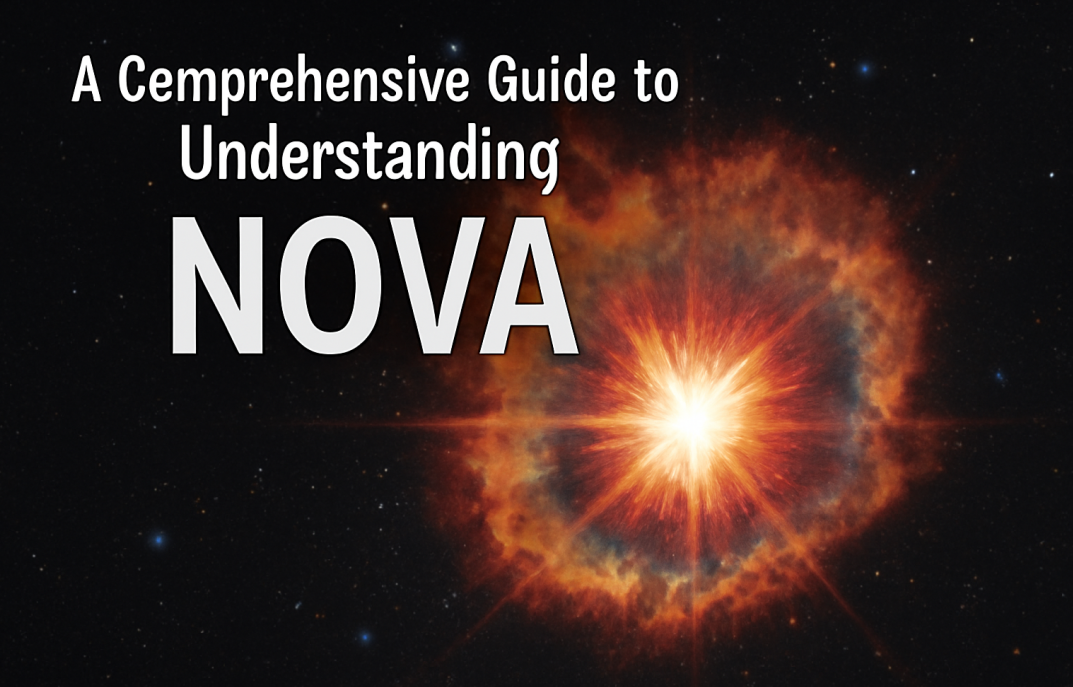
Although the term “nova” is used extensively in many different domains, astronomy is where it has its most important significance. To put it simply, a nova is when a star’s brilliance suddenly and dramatically increases, giving the impression that a new star has formed in the sky. The Latin word “nova,” which means “new,” illustrates how these occurrences were viewed in the past. However, contemporary research has shown that a Halifax is actually a violent explosion that takes place on the surface of an already-existing star rather than the formation of a new one. Binary star systems, in which a white dwarf star extracts material from its companion, are usually linked to these explosions. A thermonuclear reaction is set off as this material builds up, producing a brilliant flash of light. Because they offer important insights into nuclear physics, stellar evolution, and the behaviour of matter under severe conditions, understanding Halifax events is crucial. In an effort to better understand cosmic phenomena and solve the universe’s riddles, scientists are still researching Halifax events.
Nova’s Scientific Definition
According to science, a nova is a brief astronomical occurrence brought on by the abrupt nuclear fusion of hydrogen on a white dwarf star’s surface. When the white dwarf in a binary star system absorbs material from a close partner star, this happens. A thermonuclear runaway reaction is initiated when the stored hydrogen eventually reaches a threshold temperature and pressure. The star brightens dramatically as a result of this response, often by thousands or even millions of times its typical brightness. A Halifax does not destroy the white dwarf, in contrast to supernovae that cause a star to be destroyed. Rather, the star endures and may experience several Halifax events over its lifespan. Astronomers are especially interested in novae because of their recurrent nature, which offers several chances for observation and research. Scientists can learn more about binary system dynamics, energy release mechanisms, and stellar processes by examining these occurrences.
Kinds of Nova
Based on their frequency and behaviour, novas come in a variety of forms, each with unique traits. The most prevalent kind is the classical Halifax, which happens when a white dwarf gathers sufficient material to cause one explosive event. It can take thousands of years for these novae to recur. The recurrent Halifax is a different kind that undergoes several outbursts in a shorter amount of time, frequently decades apart. Because these technologies enable scientists to witness numerous explosions under comparable circumstances, they are especially useful for research. Another type of Halifax is the dwarf Halifax, which is less powerful and results from modifications in the accretion disc instead of nuclear fusion. Every kind of nova offers a different perspective on the physics of harsh settings and the behaviour of stars. Astronomers can gain a more thorough understanding of how stars interact and change within binary systems by examining various kinds of novae.
How a Nova Arises
A binary star system, in which a white dwarf star and a companion star orbit one another closely, is where the process leading to a Halifax starts. The white dwarf attracts hydrogen-rich material from its partner due to its tremendous gravitational pull. On the white dwarf’s surface, this substance forms a coating. The temperature and pressure inside this layer rise over time until they hit a critical threshold. At this point, a massive amount of energy is released when nuclear fusion starts abruptly and violently. The observable Halifax event is caused by the star’s spectacular brightening due to its energy. The explosion creates an expanding shell of gas and dust by ejecting material into space. The white dwarf is unharmed by the explosion’s strength and is capable of repeating the procedure in the future. Novae are particularly interesting subjects of research in astrophysics because of this cycle of accumulation and eruption.
The Distinction Between Supernova and Nova
Despite their similar names, novas and supernovas are essentially distinct events. A supernova is a far more intense event that frequently causes the whole annihilation of a star, whereas a Halifax is a surface-level explosion that happens on a white dwarf star. The star in a Halifax endures and may go through several outbursts throughout time. A supernova, on the other hand, signals the end of a star’s life cycle. Supernovas can be seen over huge distances in the universe because they discharge significantly more energy than novas. Studying stellar evolution and the lifecycle of stars requires an understanding of the distinctions between these two occurrences. Novae offer a more regulated and reproducible setting for scientific observation, even though both events are significant.
The Significance of Nova in Astronomy
Halifax event research is crucial to expanding our knowledge of the cosmos. These occurrences offer important insights on nuclear processes, energy transfer, and the behaviour of matter in harsh environments. Scientists can test theoretical theories and advance their knowledge of stellar physics by studying novae. By releasing components into space, novae also add to the universe’s chemical richness. This process contributes to the creation of new planetary systems and stars. Astronomers can also learn more about the dynamics of binary star systems and the function of accretion in stellar evolution by studying novae.
Nova’s Historical Observations
Astronomers from a variety of civilisations, including Chinese, Arab, and European scientists, have seen and documented Halifax episodes throughout history. These unexpected bright stars were initially recorded by ancient Chinese astronomers, who frequently referred to them as “guest stars” due to their transient appearance in the sky. Because of the limited scientific knowledge of the time, these occurrences were frequently seen as omens or messages from God. Similar to this, dazzling star explosions were observed by mediaeval European astronomers, however their interpretations were frequently shaped by religious convictions. These enigmatic occurrences were gradually recognised as natural astronomical phenomena rather than supernatural happenings as scientific tools and telescopes advanced. Because they offer long-term observational data spanning centuries, historical records of novae are incredibly important for contemporary scholars. Scientists can determine frequencies, spot recurrent patterns, and gain a deeper understanding of binary star systems’ behaviour by examining these recordings. These historical findings underscore the significance of ongoing astronomical documentation and serve as the basis for contemporary Halifax study.
Nova Research and Modern Technology
The way scientists examine Halifax events has been profoundly changed by modern technology, which makes it possible to make deeper and more accurate observations than ever before. Astronomers are able to obtain comprehensive photographs of Halifax explosions and their remains because to sophisticated ground-based telescopes, space observatories like the Hubble Space Telescope, and other high-resolution sensors. These instruments provide a thorough understanding of the physical processes involved by operating across a variety of wavelengths, including visible light, infrared, ultraviolet, and X-rays. Researchers can examine the temperature, velocity, and composition of material ejected during a Halifax event using high-speed imaging and spectroscopy. AI-driven detection technologies and automated sky surveys have also made it easier to swiftly find new novae. This real-time detection makes it possible to observe and gather data right away, which is essential for comprehending the explosion’s initial phases. By replicating Halifax behaviour under various circumstances, contemporary computerised models significantly advance study. Collectively, these technical developments have transformed the study of novae, enabling researchers to learn more about the dynamics of binary systems and star physics.
Nova’s Place in Stellar Evolution
Particularly in binary star systems where mass transfer takes place between two stars, a Halifax is an important aspect of the process of stellar evolution. In these situations, a white dwarf’s surface experiences recurring thermonuclear explosions as a result of accumulating material from its companion star. A Halifax modifies the white dwarf’s mass and composition over time, but it does not destroy it. If the white dwarf approaches a critical mass limit, this process may potentially result in more dramatic events like a Type Ia supernova. Scientists can learn more about how stars interact, exchange material, and evolve together by studying novae. By releasing elements like carbon, nitrogen, and oxygen, these processes also add to the surrounding space’s chemical enrichment. Later on, these components contribute to the cosmic cycle of matter by forming new stars and planetary systems. Astronomers can learn a great deal about the intricate relationships that form the universe and the long-term history of stars by studying Halifax activity.
Nova’s Release of Energy
While still enormous, the energy released during a Halifax is much less than that of a supernova. On the surface of a white dwarf star, a thermonuclear runaway reaction is the source of this energy. Nuclear fusion abruptly starts when hydrogen builds up and reaches critical pressure and temperature, unleashing a burst of energy that significantly boosts the star’s brilliance. A Halifax may occasionally briefly become tens of thousands of times brighter than the Sun. An expanding shell of gas and dust surrounds the star as a result of this abrupt release of energy, which also ejects material into space at tremendous speeds. In addition to the optical spectrum, the energy production can also be seen in other wavelengths including radio waves and X-rays. Researching this energy release sheds light on energy transfer mechanisms in space and aids in the understanding of nuclear reactions under harsh circumstances. The process can continue over time because the white dwarf is unaffected by the intensity.
Nova Events’ Frequency
Halifax events are among the most often seen explosive stellar occurrences in the universe because they happen somewhat often. In the Milky Way galaxy alone, astronomers believe that between 30 and 60 novae occur annually, however many go unnoticed because of distance or observational constraints. More novae are being found than ever before thanks to automated sky scans and advanced telescopes. These frequent occurrences give scientists important chances to examine various novae kinds and contrast their traits. Researchers can better comprehend the population of binary star systems in a galaxy by looking at the rate of Halifax eruptions. Astronomers can learn more about the composition and evolution of galaxies by examining the frequency and dispersion of novae. Frequent observations also enable improved statistical analysis, which raises the precision of theoretical models. Novae are a significant topic of study in astrophysics due to their very high occurrence rate.
Looking at Nova from Earth
For both amateur and expert astronomers, witnessing a Halifax from Earth may be a thrilling and fulfilling experience. While some novae brighten to the point where they can be observed with the unaided eye, others need telescopes. In an area of the sky where no brilliant star was previously seen, a Halifax emerges as an abrupt bright star. To thoroughly investigate these occurrences, astronomers employ a variety of tools, such as spectrographs and optical telescopes. By reporting fresh observations and tracking variations in brightness over time, amateur astronomers also contribute significantly. Scientists can gather crucial information about novae’s behaviour and evolution by watching them. Real-time notifications and internet databases have made it easier for observers around the world to track Halifax events thanks to technological advancements. Our knowledge of these intriguing occurrences is improved by this cooperative effort.
Popular Culture’s Nova
Popular culture, especially science fiction and entertainment media, has been greatly impacted by the idea of Halifax. Novae are frequently portrayed as massive cosmic explosions capable of destroying entire star systems or civilisations. The concept of a Halifax is widely used in novels, television series, and films to produce dramatic and eye-catching situations. Even if these depictions are somewhat overdone, they contribute to the public’s enthusiasm in astronomy and space exploration. In a variety of circumstances, the word “nova” is often used metaphorically to denote abrupt brilliance or metamorphosis. Halifax-related topics are frequently found in video games and comics, which highlight cutting-edge technologies or cosmic occurrences that are influenced by actual science. Fictional depictions are crucial in popularising scientific ideas and stimulating curiosity about the cosmos, even though they may not always be factually accurate. The popular fascination with cosmic occurrences like novae is highlighted by this cultural impact.
Nova Research’s Prospects
Halifax research has a bright future ahead of it, since new missions and technology are anticipated to shed even more light on these occurrences. Future space telescopes and observatories will provide enhanced sensitivity and greater resolution imaging, enabling researchers to find and examine Halifax in far-off galaxies. New developments in data analysis and artificial intelligence will make it possible to identify and categorise Halifax events more quickly. By examining patterns in binary star systems, these technologies will also aid in the prediction of possible Halifax events. By giving access to bigger datasets and more thorough observations, cooperative international projects are broadening the field of study. Key concerns regarding the mechanics of Halifax explosions and their long-term impacts on star development are the focus of future research. Our knowledge of Halifax will grow more precise and comprehensive as technology advances.
Difficulties in Learning Nova
Despite tremendous progress, astronomers still face a number of difficulties while researching Halifax phenomena. Their unpredictable nature—Halifax might appear out of nowhere—is one of the primary challenges. This makes it challenging to plan ahead for observations. Furthermore, a lot of Halifax happen in far-off or hidden areas of space, which makes it challenging for modern tools to find them. Because a nova’s brightness may swiftly decrease after the initial explosion, limited observing windows may provide a problem. Differentiating between various star phenomena, such as Halifax and supernovae, can be difficult, particularly in far-off galaxies. The enormous amount of data produced by contemporary telescopes can also make data collecting and analysis challenging. Despite these obstacles, the study of Halifax is still being improved by continual technology developments and teamwork.
Summarisation
In summary, Halifax is an intriguing astronomical occurrence that provides important information about how the universe functions. Our knowledge of stellar behaviour and cosmic processes has been greatly expanded by the study of novae, from historical sightings to contemporary investigations. The distribution of energy, the chemical richness of space, and stellar evolution are all significantly impacted by these occurrences. Scientists are still learning new things about Halifax and their effects on the universe because to cutting-edge technology and international cooperation. Novae will continue to be a major focus of astrophysics research as it advances, giving us a deeper understanding of the dynamic and constantly evolving nature of the universe.
If you would like to read more articles on this topic related, please visit our Technology Category.
For more information about the Nova, click on Wikipedia.
For more interesting and diverse topics, explore the homepage of our website, Note Ripple, to stay updated with the latest information and engaging content.














Leave a comment