

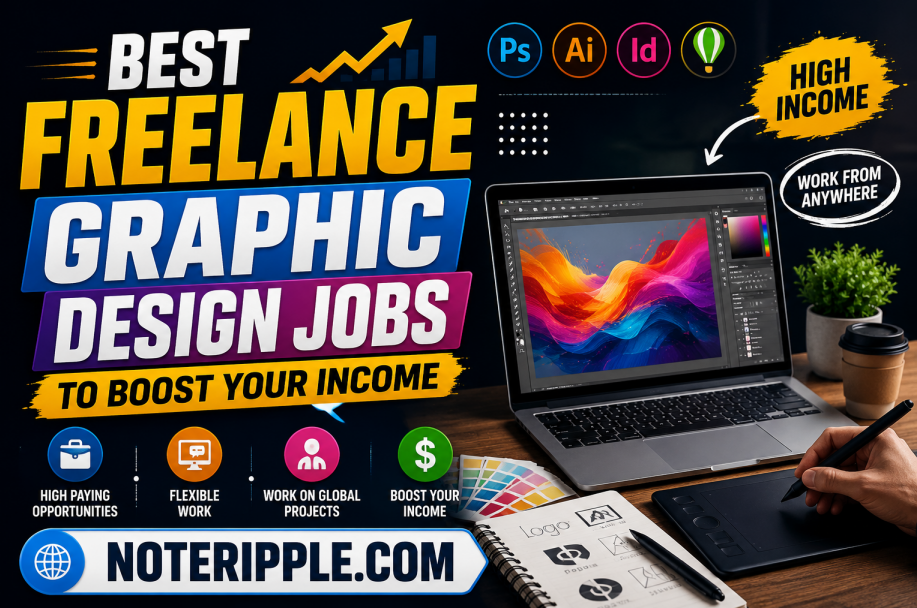
Today we are talking about freelance graphic design jobs. As companies, startups, content producers, and eCommerce brands depend more and more on expert visual content to bolster their online presence, the need for freelance graphic design tasks has surged. Skilled freelance graphic designers have more options than ever to develop a lucrative career while taking advantage of the freedom of working remotely, from designing user interfaces and marketing materials to producing memorable logos and social media visuals.
In contrast to typical employment, freelancing gives designers the freedom to select their clients, create their own schedules, and set their own prices according to their experience and level of expertise. But it takes more than just ingenuity to win in this cutthroat field. In order to continuously produce high-quality work that satisfies customer expectations, designers must comprehend market need, acquire specific abilities, and construct an outstanding portfolio.
Whether you’re just starting your freelancing adventure or looking to enhance your monthly revenue, picking the correct design specialization will drastically improve your earning potential. Some freelance graphic design jobs offer regular long-term tasks, while others provide high-paying one-time contracts with global clients.
In this comprehensive guide, you’ll discover the best freelance graphic design jobs available today, the skills required to succeed, the highest-paying design specialties, trusted platforms for finding clients, pricing strategies, portfolio-building techniques, and practical tips to help you establish a sustainable and rewarding freelance career.
Why Freelance Graphic Design Jobs Are Growing Faster Than Traditional Design Careers
The freelancing economy has altered the way firms hire creative professionals. Instead of retaining huge in-house design teams, many organizations increasingly prefer working with freelance graphic designers since it enables flexibility, minimizes operational expenses, and allows access to specialized talent from around the world. For designers who choose to work independently, this change has produced thousands of new options.
This expansion has been greatly aided by digital marketing. Website banners, advertisements, social media graphics, email campaigns, product packaging, presentations, and brand identity materials have become essential for businesses competing online. Companies featured in the Note Ripple Business Category increasingly seek skilled freelance graphic designers to strengthen their branding and digital presence. As online businesses continue to expand, the demand for experienced freelance designers continues to grow across multiple industries.
Geographical restrictions have also been removed via remote work. With the use of cloud-based design software, video conferencing, and project management tools, a designer from anywhere in the world may now work with clients in various nations. Freelancers can make a lot more money on this international market than they might with only local chances.
The proliferation of startups and small firms is another element propelling industry expansion. Many business owners frequently need expert design services but cannot afford to hire a full-time designer. By offering affordable solutions on a project or retainer basis, freelancers close this gap.
The sector has undergone additional changes due to artificial intelligence. While AI technologies can assist with repetitive chores and speed up workflows, they cannot replace human creativity, strategic thinking, branding knowledge, or the ability to comprehend a client’s unique vision. Designers can enhance their overall productivity and finish projects more quickly by learning to combine strong creative talents with AI-powered technologies.
As businesses continue investing in digital branding, advertising, and user experience, freelance graphic design remains one of the most reliable and profitable online career pathways for creative people.
15 Best Freelance Graphic Design Jobs That Can Boost Your Income in 2026
The profit potential in each design area varies. Some freelance graphic design tasks are consistently in great demand since businesses use these services throughout the year. Specializing in one or more of these areas will help you attract better clients, earn higher prices, and develop a sustainable freelance career.
1. Logo Design
Logo design is one of the most sought-after freelance services since companies require memorable logos to build their brand identity.
2. Brand Identity Design
Beyond logos, firms demand comprehensive branding packages that include typography, color palettes, brand standards, and marketing assets.
3. Graphics for Social Media
Businesses, agencies, and content producers are always in need of captivating visuals for social media sites like Facebook, Instagram, LinkedIn, and Pinterest.
4. UI Design for Websites
Modern websites require clear, user-friendly interfaces that improve user experience and promote company goals.
5. Landing Page Design
High-converting landing pages help organizations generate leads and increase sales, making this a crucial specialization.
6. Design of Packaging
Manufacturers and online retailers make significant investments in eye-catching packaging that affects consumers’ decisions to buy.
7. Product Label Design
Expert labels convey crucial company information while making products stand out on retail shelves.
8. Presentation Design
Corporate organizations typically hire designers to develop sophisticated presentations for investors, clients, and internal meetings.
9. Infographic Design
Infographics that are visually appealing are used in marketing and education to make complex information easier to understand.
10. Book Cover Design
Authors and publishers want captivating book covers that capture consumers’ attention both online and in print.
11. Email Marketing Graphics
To increase click-through rates and conversions, businesses using email campaigns rely on captivating images.
12. Creative Advertising
Display ads, banner ads, and promotional visuals are vital components of digital marketing strategies.
13. Graphics in Motion
Short promotional movies and animated visuals are becoming more and more common on digital advertising platforms and social media.
14. YouTube Thumbnail Design
Content producers always want high-quality thumbnails because they increase video click-through rates.
15. AI-Powered Creative Design
In order to create distinctive, superior visual assets, many businesses increasingly look for designers that can successfully blend AI-generated designs with expert editing, branding, and creative refinement.
Rather than striving to master every design discipline, focus on gaining competence in two or three high-demand areas. Developing a solid reputation in a niche enables you to charge higher prices, draw in repeat business, and establish a more reliable source of income while consistently growing your portfolio.
Which Freelance Graphic Design Jobs Pay the Highest? (Salary & Income Comparison)
One of the main advantages of pursuing freelance graphic design jobs is the opportunity to increase your income by specializing in services that deliver measurable value to clients. Every design niche has the potential to generate income, but some specialties command higher rates because they directly contribute to a business’s branding, customer experience, or revenue growth.
For example, brand identity design is among the highest-paying freelance services because businesses consider branding as a long-term investment rather than a one-time purchase. A full branding package is far more valuable than just creating a logo because it typically includes a logo, color scheme, typography, brand guidelines, business stationery, and marketing materials.
UI/UX design is another premium niche. Freelance designers are frequently hired by technology companies, SaaS companies, and startups to develop user-friendly dashboards, mobile app interfaces, and websites that increase user engagement and conversions. Since user experience directly influences company performance, professional UI designers can charge premium hourly or project-based prices.
Packaging design also remains incredibly profitable. Consumer brands recognize that attractive packaging influences purchasing decisions, especially in competitive retail and eCommerce sectors. Designers that understand branding, printing requirements, and consumer psychology are generally rewarded with recurrent business.
Motion graphics, presentation design, and advertising creatives continue to experience strong demand as businesses invest more heavily in digital marketing and video content. Meanwhile, designers specializing in YouTube thumbnails, social media campaigns, and digital advertisements often build long-term partnerships with agencies and content creators that require ongoing design support through freelance graphic design jobs.
Successful freelancers present themselves as experts who resolve company issues rather than competing only on pricing. Compared to designers who merely produce eye-catching images, clients are typically prepared to pay more for designers who comprehend branding, marketing goals, and consumer behavior.
Before Applying for Graphic Design Jobs, Every Freelancer Needs to Learn These Skills
Seldom is talent sufficient to create a profitable freelance business. Clients want independent graphic designers to combine technical expertise with communication, organizing, and problem-solving skills. Having a well-rounded skill set enables independent contractors to consistently do quality work while earning clients’ trust.
The foundation of every graphic designer’s career begins with learning professional design concepts. Viewers’ perceptions of companies and marketing materials are influenced by typography, color theory, composition, spacing, visual hierarchy, and layout design. Designers who grasp these principles create work that is not just visually beautiful but also successful in delivering messages.
Equally vital is skill in industry-standard software. Professional designers still need Adobe Photoshop, Illustrator, InDesign, and Figma, while Canva and Adobe Express are useful for producing fast marketing materials. Familiarity with these applications enables freelancers to manage a wide variety of client jobs efficiently.
Another ability that frequently sets successful freelancers apart from novices is communication. Understanding project needs, asking appropriate questions, justifying design decisions, and responding professionally to criticism all contribute to stronger client relationships. Clear communication decreases misconceptions and enhances the likelihood of receiving repeat work.
Effective time management is equally important. Freelancers frequently oversee several clients at once, so it’s critical to set priorities, adhere to deadlines, and keep workflows structured. Delivering projects on time promotes referrals and helps establish a good reputation.
Lastly, in a field that is changing quickly, ongoing education is essential. Design changes, software updates, accessibility standards, and AI-assisted workflows continue to reshape the profession. Investing in skill development helps freelancers stay competitive, broaden their service offers, and eventually boost their earning potential.
Top Resources for Time-Saving Freelance Graphic Design Jobs
One of the most difficult things for new freelancers is finding good clients, but the learning curve can be greatly reduced by selecting the appropriate platforms. Instead of applying everywhere, focus on marketplaces that match your expertise level, specialization, and long-term company ambitions.
With thousands of graphic design assignments in branding, web design, advertising, presentations, and digital marketing, Upwork is still one of the biggest freelance markets. Long-term contracts might result from developing a solid profile, crafting customized bids, and keeping up stellar client testimonials.
By enabling independent contractors to design service bundles that customers buy directly, Fiverr operates in a different way. Designers that clearly explain their services, exhibit great portfolio samples, and execute consistently high-quality work generally obtain repeat orders and positive evaluations.
Professionals with experience can think about using Toptal, which has a strict vetting procedure but links independent contractors with high-end foreign clientele prepared to pay more. In a similar vein, Contra has grown in popularity since it lets independent contractors keep a larger portion of their profits without having to pay platform commissions.
Additionally, creative people ought to keep active portfolios on Dribbble and Behance. Many companies, startups, and recruiters utilize these platforms to uncover exceptional designers for freelance and full-time positions. Without submitting proposals, a well-structured portfolio with thorough case studies might lead to direct client queries.
Another effective tool that many independent contractors undervalue is LinkedIn. Optimizing your profile, sharing design insights, publishing case studies, and networking with marketing professionals can produce high-value commercial prospects over time.
While freelance platforms are fantastic starting points, competent designers eventually expand their client acquisition strategy through referrals, personal websites, social media marketing, and direct outreach to firms. This balanced strategy generates a more stable and predictable income.
How to Build a Graphic Design Portfolio That Attracts High-Paying Clients
Your portfolio is your best marketing tool, not just a collection of eye-catching designs. Potential clients use it to evaluate your creativity, technical ability, problem-solving skills, and professional experience before deciding whether to hire you.
Choose your best work that best represents the kind of clients you hope to draw in rather than sharing every project you’ve finished. Quality always matters more than quantity. A portfolio with ten outstanding work makes a bigger impact than one with dozens of mediocre ideas.
A succinct case study outlining the client’s goal, your design approach, the difficulties you overcame, and the finished product should be included with every project. Instead of evaluating your work based only on look, clients are better able to comprehend the value behind your job when you exhibit your strategic thinking.
Sort your portfolio into distinct categories, such as motion graphics, branding, social media graphics, website design, packaging, and presentations. Potential clients will find it easier to locate pertinent samples for their projects thanks to this arrangement.
Professional presentation also matters. Maintain consistent typography, spacing, image quality, and branding throughout your portfolio website or profile. A clean, user-friendly style demonstrates your attention to detail and professionalism.
Finally, update your portfolio regularly. As your skills develop, replace previous projects with stronger work that better represents your current ability. Including client success stories, quantifiable achievements, and testimonials boosts your reputation and gives potential customers confidence that you can produce excellent results.
In addition to showcasing your creativity, a well-thought-out portfolio establishes you as a reliable expert who can handle actual business problems, which is crucial for drawing in higher-paying freelance graphic design work.
How to Set Prices for Freelance Graphic Design Work Without Losing Customers
One of the most crucial choices a freelance graphic designer must make is how much to charge. Charging too little can undervalue your talents and make it difficult to develop a sustainable firm, while charging too much without demonstrating value may deter potential clients. The idea is to design a pricing strategy based on your skills, the complexity of the project, and the results your effort can offer.
Most freelancers employ one of three pricing models: hourly, fixed-price, or value-based pricing. Hourly pricing works effectively for ongoing projects where the scope may fluctuate, whereas fixed price provides clarity for both the freelancer and the client on precisely defined tasks. Because value-based pricing emphasizes the commercial benefit of your work rather than the time spent developing it, it is frequently the most profitable.
Always explain what your fee includes, such as the number of revisions, file formats, delivery time, and ownership rights. A thorough proposal avoids misunderstandings and sets clear expectations right away.
Contract utilization is equally crucial. Payment terms, milestones, deadlines, change restrictions, cancelation procedures, and intellectual property rights should all be included in every project. This protects both parties and exhibits professionalism.
Don’t compete only on price. Customers that are searching for the least expensive designer are frequently the most picky. Instead, stress your experience, communication skills, reliability, and ability to produce designs that assist organizations reach their goals. As your portfolio expands and you receive favorable testimonials, gradually increase your charges to reflect your knowledge and the value you deliver.
Proven Strategies to Win More Freelance Graphic Design Jobs Every Month
One of the most difficult things about working as a freelancer is finding clients on a regular basis, but great designers approach marketing as a continuous business activity rather than something they do only when work slows down. A consistent pipeline of opportunities comes from developing visibility, earning trust, and sustaining great customer relationships.
Your freelance profile should clearly convey the challenges you tackle instead of merely listing design talents. Customers want to know how your work will help their marketing campaigns, boost engagement, or enhance their brand. A fascinating profile matched with a competent portfolio immediately improves credibility.
Don’t send generic templates while submitting bids. Explain how your experience connects to the client’s project after carefully reviewing their criteria. Mention comparable projects you’ve done, pose intelligent queries, and outline the benefits you can offer. Personalized pitches often receive much greater response rates.
Networking also plays a vital role. Share case studies, design insights, and finished projects on Behance, Dribbble, LinkedIn, and other pertinent online forums. Consistent visibility helps attract inbound inquiries from new clients.
Once a job is finished, ask for a testimonial and stay in touch with happy customers. Compared to always looking for new contracts, working with repeat clients is frequently easier and offers a more consistent revenue. The lifetime value of each client connection can also be raised by providing supplementary services like presentation design, social media graphics, or branding updates.
Consistency, professionalism, and outstanding communication remain the most effective tactics for landing freelance graphic design assignments throughout the year.
Typical Errors in Freelance Graphic Design That Keep Designers at Low Pay
Many gifted designers have financial difficulties due to business errors that impede their development rather than a lack of creativity. Recognizing and avoiding these typical pitfalls can considerably increase your long-term success.
One of the biggest blunders is underpricing services. Many newcomers decrease their fees to attract clients, but this typically leads to enormous workloads, unpleasant discussions, and restricted profitability. Competitive price should reflect your talents, experience, and the value your service gives.
Another prevalent problem is poor communication. Failing to communicate project requirements, timeframes, or revision expectations can generate misconceptions that undermine client relationships. Effective communication enhances project results and fosters trust.
Some freelancers also overlook contracts and written commitments. Working without specified agreements raises the likelihood of payment disputes, scope creep, and unreasonable client expectations.
Attempting to service every kind of customer is another error. In comparison to generalists, designers who specialize in a particular field—such as branding, UI design, packaging, or social media marketing—often gain greater skill and earn higher fees.
Ignoring constant learning might also limit career progress. Design trends, software updates, accessibility standards, and AI-assisted workflows move swiftly. Investing in education helps you remain competitive and extend your offerings.
Lastly, a lot of independent contractors fail to recognize the significance of personal branding. Attracting greater possibilities and building long-term credibility are facilitated by a professional website, a consistent portfolio, an active social media presence, and positive client testimonials.
Crucial Resources Every Independent Graphic Designer Needs to Work Quicker and Make More Money
Professional designers employ specific tools that enhance productivity, teamwork, and overall project quality in addition to creativity. Freelancers can finish assignments more quickly while upholding professional standards by selecting the appropriate software.
For digital artwork, image manipulation, and photo editing, Adobe Photoshop continues to be the industry standard. Adobe Illustrator is perfect for creating scalable vector images such as logos, icons, and illustrations, while Adobe InDesign is extensively used for brochures, magazines, and multi-page projects.
Figma has become one of the most popular tools for UI and UX design since it offers real-time collaboration and cloud-based workflows. Canva Pro and Adobe Express are great for developing marketing materials rapidly, especially for clients demanding frequent social media content.
Freelancers may effectively manage many client projects, track deadlines, and organize tasks with the use of project management applications like Notion, Trello, and ClickUp. Cloud storage services like Dropbox and Google Drive make it easier to share files and guarantee that project materials are safe and available.
AI-powered solutions can also boost productivity by assisting with ideation, image production, backdrop removal, content management, and repetitive editing activities. However, these tools should enhance—not replace—creative thinking and strategic design judgments.
You can increase client satisfaction, handle more work without sacrificing quality, and complete projects more quickly by choosing tools that fit your workflow.
Future Trends Shaping Freelance Graphic Design Jobs Over the Next Five Years
The graphic design industry is constantly evolving due to changes in customer behavior, emerging technologies, and digital marketing strategies. Professionals working in freelance graphic design jobs who understand these trends will be better positioned to stay competitive, attract high-value clients, and grow successful businesses.
Artificial intelligence is likely to become a beneficial creative helper rather than a replacement for skilled designers. Designers may concentrate on strategy, storytelling, branding, and creative direction by using AI to automate monotonous activities, develop concepts, and expedite production.
As companies boost their investments in digital advertising and social media marketing, the demand for motion graphics and short-form video content is rising. There will be more revenue potential for designers who are knowledgeable in animation and video design.
It is anticipated that interface design and user experience will continue to be high-growth specialties. As organizations prioritize customer experience across websites and mobile applications, competent UI/UX designers will continue to earn premium fees.
Personal branding has become increasingly crucial for entrepreneurs, influencers, and executives, producing significant demand for visual identity systems, presentation design, and digital content creation.
As businesses look for eco-friendly packaging and inclusive digital experiences, sustainability and accessibility are impacting contemporary design methods. The value of designers who understand ethical design principles and accessibility rules will grow.
Freelancers who consistently learn, adapt to emerging technology, and build specific knowledge will be well positioned to prosper in the dynamic creative environment.
FAQS
Can novices without any professional expertise begin working as freelance graphic designers?
Indeed. Beginners can develop a portfolio utilizing personal projects, redesign thoughts, charity work, or practice tasks before looking for paid freelance possibilities.
Which freelance graphic design niche pays the most?
Brand identity design, UI/UX design, package design, motion graphics, and product design often offer some of the best earning potential since they deliver measurable business value.
Do I need a university degree to become a freelance graphic designer?
No. Most clients examine your portfolio, communication skills, and ability to deliver excellent work rather than your academic degrees.
How long does it take to attract freelance clients?
The timeline varies depending on your portfolio, marketing activities, networking, and proposal quality. Consistent outreach and continual improvement usually provide better results over time.
Should I specialize or offer several services?
It is frequently simpler to develop expertise and draw in ideal clientele when you start with a narrowly defined niche. You can progressively broaden your offerings as your experience increases.
Is it possible to work as a freelance graphic designer full-time?
Of course. By retaining recurring clients, honing their abilities, raising their fees, and creating effective workflows, many prosperous independent contractors create long-term enterprises.
Final Thoughts
Freelance graphic design gives far more than creative freedom—it provides an opportunity to develop a flexible, prosperous, and sustainable profession serving clients across the world. Although success takes time, designers who continuously develop their abilities, produce exceptional portfolios, communicate well, and concentrate on providing genuine business value frequently build long-term careers with high earning potential.
Rather than trying to learn every design discipline, begin by identifying a specialization that suits your passions and market demand. Continue picking up new skills, keep up with business trends, adopt technology that boost efficiency, and uphold solid client connections. These practices will eventually boost your rates, improve your reputation, and create a constant flow of chances.
Whether your objective is to earn extra cash, replace a traditional employment, or establish a full-service creative firm, the growing demand for freelance graphic design projects makes now a great moment to invest in your talents and start constructing the career you desire.
Stay informed with Invest Daily Times for trusted freelancing news, expert career insights, and in-depth coverage of freelance graphic design jobs, remote work opportunities, design industry trends, client acquisition strategies, pricing tips, and creative business growth. Follow us on Facebook, Instagram, and Twitter for the latest freelancing updates, expert guidance, and actionable advice to help you build a successful graphic design career and boost your income with confidence.











Leave a comment